Websites & E-commerce
Fast, accessible, search-optimised sites built to be owned outright rather than rented from a page-builder subscription. Your customer data stays yours.
More on websitesAbout
We run on the same tools we build for clients. Older agencies are often carrying layers that AI has made unnecessary. We started with those tools already in place, so there is no fat to trim meaning no unneeded overheads you end up paying for. You benefit from senior staff from start to finish.
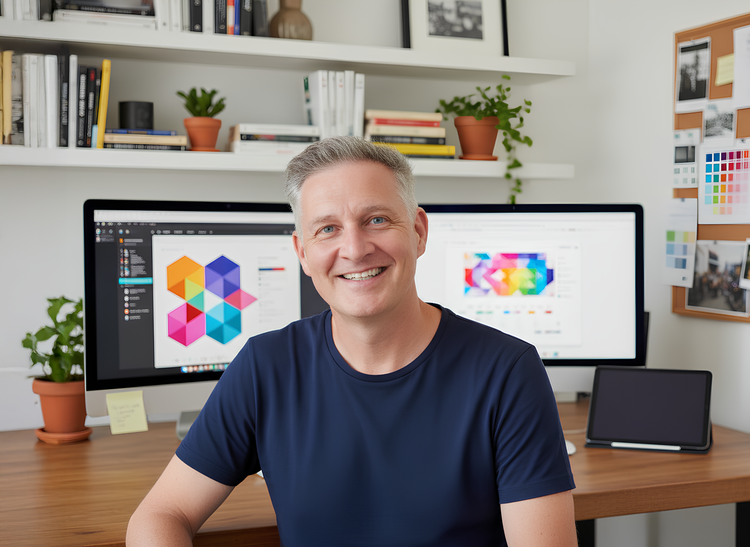
Founder · Simon Lambert
Simon has worked in technology since the late 1980s — programming, infrastructure, operations, business analysis, software design and strategy - though not necessarily in that order!
The consultancy years gained momentum around the turn of the millennium, advising businesses on disaster recovery and business continuity when Y2K had the entire industry awake at night. Supporting systems for organisations that could not afford to be offline including Barclays Bank, ICI, SKY, Local Authorities and many more.
He then founded and ran an internet hosting company, where the infrastructure knowledge became practical rather than theoretical: web servers, network architecture, online software design and the sharp end of keeping other people's businesses online. Alongside it he organised large-scale computer shows at venues including the National Motorcycle Museum, helping to provide end users with the latest technology at discounted prices.
The last fifteen years have been digital commerce. SmartGiftShop grew into a platform carrying more than 25,000 verified positive customer reviews. ClubBrander followed — a branded merchandise platform for sports clubs. Both were designed, built, deployed and are still maintained in-house. Neither was a client project; both are proof that what we recommend, we can also build.
Simon is currently using the latest AI software to build custom systems for his clients. The beneficiaries range from sole traders to national organisations. A tailored website and a management system used to be something only a larger company could justify - that is no longer true. Off-the-shelf sites with a stack of plugins are the outdated option. A bespoke software solution built around how the business actually works is now affordable and it is what streamlines the work and raises productivity.
Simon's USP: I have built and run IT businesses over many years and all that knowledge gets referenced when a solution is put together. I don't just code whatever is asked for, I give my considered opinion and offer advice gleaned from my own hands on experience.
How we work
The audit comes first, then we do the work. Everyone local will sell you advice. We can advise and then build what we recommend — the person who finds the problem is the one who fixes it.
Whether you are a multi national company or a one man band, we will provide you with a completely bespoke system that will be tailored to your company's operations, maximising your productivity.
All of our software is built on our own in-house framework. Security fixes and new integration tools land in the framework first, so your system can take them without being rebuilt.
Your systems will benefit from our experience of building and running businesses. Systems that we know will deliver and maximise productivity.
Who we've worked with
Just some of the companies we have worked with to provide IT systems and solutions.
Over 1,000 exhibits and a stunning conference centre. We were approached to produce a state of the art admission and e-commerce system for one of the event organisers operating at the Museum. The system provided full event management and ticket scanning for real time attendees.
craftingrealm.co.uk
A medical-led aesthetics clinic. The system provided online bookings, management of treatment records and client communications in one place. Small, local and exactly the kind of business that our software is perfect for - maximising their potential and increasing productivity.

One of our charity projects. We provided a complimentary full ecommerce site for The Ladies First calendar launch event, promotion and ongoing calendar sales - supporting over 30 charities. We pride ourselves on delivering free charity web sites wherever we can.
ladies-first-charity.co.ukWhat we do
Websites, software, AI and security — designed, built and looked after by the same small team, long after launch.
Fast, accessible, search-optimised sites built to be owned outright rather than rented from a page-builder subscription. Your customer data stays yours.
More on websitesOne tailored system in place of the pile of disconnected tools — booking, customers, membership, stock, internal apps. No per-seat fees and no lock-in.
See what we buildAgents, document extraction and automation built into the systems you already run. Practical tools that remove repetitive work, not a strategy deck about the future.
Explore AI consultancyAccess, backups, updates and monitoring — and where the work is sensitive, a private internal network rather than the open web. AI has made attacks cheap and small businesses are the soft target.
Talk to us about securityWhy Red 4
Eddie Colman was one of Manchester United's Busby Babes and a cousin of Simon's mother. He wore the number 4 shirt. He was lost in the Munich air disaster on 6 February 1958, aged 21. The memorial clock at Old Trafford carries the date and every year the club remembers them at 3.04pm, the time of the crash in England.
The 4 is a tribute to him. It is also a reminder of why the past is worth keeping properly — that experience is the thing you cannot shortcut and that the work should be good enough to be worth someone's name.
Read the full storyTell us what your business does and what you would like to improve about your current systems. We will tell you honestly how we can help.